


PE vs. Rubber Insulation for AC Copper Pipes: Which is Better for Your Project?
 Mar 19, 2026|
 View:916
When homeowners and contractors face the critical decision of selecting insulation for air conditioning copper pipes, the choice between polyethylene (PE) and rubber materials can significantly impact system performance, longevity, and energy costs. This comprehensive guide examines the key differences between PE insulated copper pipe and rubber insulated copper pipe solutions, helping readers make informed decisions based on real-world performance data and industry standards.
Key Takeaways
Material Performance: PE insulated copper pipe offers superior moisture resistance with water absorption below 0.2%, while rubber insulation provides better flexibility in tight installation spaces
Temperature Range: Rubber insulated copper pipe handles wider temperature ranges (-40°C to +105°C) compared to PE foam (-40°C to +93°C)
Energy Efficiency: Both materials deliver thermal conductivity values between 0.033-0.038 W/m·K, meeting modern energy standards
Installation Considerations: Project requirements, environmental conditions, and budget constraints determine the optimal insulation choice
Standards Compliance: Quality products meet ASTM B280 copper tube specifications and insulation performance standards
Understanding Insulation Materials for AC Copper Pipes
Air conditioning systems rely on properly insulated copper pipes to maintain efficient refrigerant flow while preventing energy loss and condensation. The two dominant insulation materials—polyethylene foam and elastomeric rubber—each offer distinct advantages that address different installation challenges and performance requirements.
What is PE Insulated Copper Pipe?
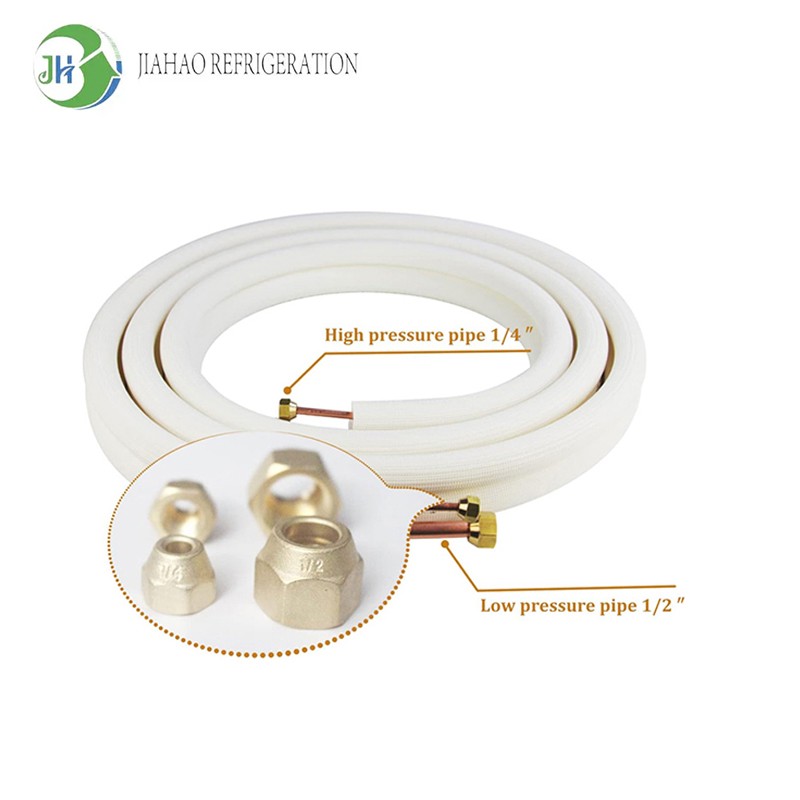
PE insulated copper pipe utilizes cross-linked polyethylene (XLPE) foam, a closed-cell thermoplastic material manufactured through specialized extrusion processes. According to materials research, PE foam achieves thermal conductivity values ranging from 0.030-0.034 W/m·K at 0°C, making it highly effective for refrigeration applications. The closed-cell structure provides exceptional resistance to moisture penetration, with water absorption rates typically below 0.20% by volume.
Modern PE insulated copper pipe products feature embossed polyethylene film and crossed-linked, foamed closed-cell construction designed specifically for high-pressure refrigerants like R410A and R32. The material's smooth surface and continuous marking every meter simplify installation while eliminating the need for additional adhesives or tapes in many applications.
What is Rubber Insulated Copper Pipe?
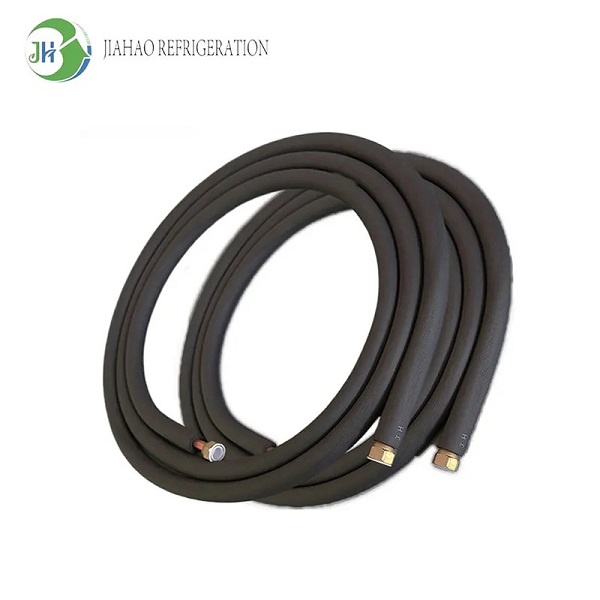
Rubber insulated copper pipe employs elastomeric foam—typically nitrile butadiene rubber (NBR) or ethylene propylene diene monomer (EPDM)—manufactured through a specialized mixing and extrusion process. Research published by industry specialists indicates that elastomeric foam insulation has served the HVAC industry for nearly 70 years, demonstrating proven reliability in diverse environmental conditions.
The flexible nature of rubber insulated copper pipe allows it to conform to irregular surfaces and complex pipe configurations without cracking or breaking. The material maintains thermal conductivity between 0.033-0.040 W/m·K while providing built-in vapor barriers that control condensation effectively. Black rubber insulation has become particularly popular for outdoor installations due to its UV resistance and weather durability.
Technical Performance Comparison
Understanding the technical specifications helps contractors and property owners select the appropriate insulation material for specific project requirements. The following comparison examines key performance metrics that directly impact system efficiency and longevity.
| Performance Factor | PE Insulated Copper Pipe | Rubber Insulated Copper Pipe |
|---|---|---|
| Thermal Conductivity | 0.030-0.035 W/m·K @ 0°C | 0.033-0.040 W/m·K @ 0°C |
| Water Absorption | < 0.20% by volume | < 0.96% after 28 days |
| Operating Temperature Range | -40°C to +93°C | -40°C to +105°C |
| Density | 28-35 kg/m³ | 65-100 kg/m³ |
| Flexibility | Good (may stiffen below -20°C) | Excellent (maintains flexibility to -65°C) |
| UV Resistance | Moderate (coating recommended) | Good (EPDM), Moderate (NBR/PVC) |
Energy Efficiency and Thermal Performance
Both PE insulated copper pipe and rubber insulated copper pipe deliver comparable thermal performance that meets or exceeds requirements outlined in ASHRAE 90.1 energy standards. The closed-cell structure of both materials creates thousands of tiny sealed air pockets that resist heat transfer, maintaining refrigerant temperatures throughout the system.
For typical residential air conditioning applications, PE insulated copper pipe with 13mm wall thickness provides an R-value of approximately 0.70, while rubber insulated copper pipe of similar thickness achieves R-values between 0.60-1.10 depending on specific formulation. These values ensure effective condensation control and energy conservation in most climate zones.
Installation Considerations and Project Requirements
The decision between PE insulated copper pipe and rubber insulated copper pipe often depends on specific installation challenges and environmental factors rather than thermal performance alone. Professional installers consider multiple factors when recommending insulation materials for different applications.
When PE Insulated Copper Pipe Excels
Polyethylene insulation demonstrates superior performance in applications where moisture exposure presents significant concerns. The material's exceptionally low water absorption rate—often below 0.005 g/100cm²—makes PE insulated copper pipe ideal for outdoor installations in humid climates or areas with frequent precipitation. The continuous pre-insulated design eliminates joints and seams that could compromise moisture barriers.
Cost-conscious projects frequently benefit from PE insulated copper pipe solutions, as polyethylene manufacturing processes typically result in lower material costs compared to elastomeric rubber. The lightweight nature of PE foam (density around 28-35 kg/m³) also reduces shipping expenses and simplifies handling during installation, particularly for long pipe runs in residential split-system air conditioners.
When Rubber Insulated Copper Pipe Performs Better
Commercial installations and variable refrigerant flow (VRF) systems often require the enhanced flexibility and temperature tolerance that rubber insulated copper pipe provides. The material maintains pliability even at extreme low temperatures (down to -65°C for EPDM formulations), allowing installers to work efficiently in cold weather conditions without material brittleness.
Projects involving complex piping configurations with numerous bends, elbows, and tight spaces benefit from rubber's superior conformability. The material can be fabricated into custom fitting covers in the shop or field, ensuring complete insulation coverage at joints and connections where heat loss typically occurs. Additionally, rubber insulated copper pipe resists cracking and breaking better than rigid alternatives, reducing material waste during installation.
Ready to Select the Right Insulation for Your Project?
JIAHAO offers both premium PE insulated copper pipe and rubber insulated copper pipe solutions manufactured to the highest industry standards. With over 13 years of HVAC expertise and comprehensive certifications including ISO 9001, ISO 14001, and ISO 45001, JIAHAO delivers reliable insulation products backed by three-year warranties.
Moisture Control and Condensation Prevention
Effective moisture management represents one of the most critical functions of air conditioning pipe insulation. Uncontrolled condensation leads to water damage, mold growth, and corrosion under insulation (CUI)—issues that compromise both system performance and building integrity.
How PE Insulation Controls Moisture
PE insulated copper pipe achieves moisture control through its closed-cell structure and integrated vapor barrier. With water vapor permeability typically limited to 0.0051 g/100cm² maximum, polyethylene foam effectively prevents atmospheric moisture from reaching cold pipe surfaces where condensation would otherwise form. The seamless construction of pre-insulated PE copper pipe eliminates potential moisture entry points at joints.
Testing data shows that PE foam maintains its insulation properties even when exposed to varying humidity levels, as the material's practically zero water absorption ensures stable thermal performance across different environmental conditions. This characteristic makes PE insulated copper pipe particularly valuable in coastal regions or areas with high relative humidity.
How Rubber Insulation Prevents Condensation
Rubber insulated copper pipe incorporates a built-in vapor retarder as part of its outer surface skin, creating an integrated moisture barrier without requiring additional jacketing materials. Quality elastomeric foam maintains water vapor permeability (WVP) ratings as low as 0.01 perm-inch—comparable to cellular glass insulation—significantly reducing the likelihood that supplemental vapor barriers will be needed.
The high water vapor diffusion resistance (μ > 10,000) of rubber insulation means that moisture molecules encounter substantial resistance when attempting to penetrate the insulation layer. This property proves particularly important for below-ambient piping systems like chilled water lines and refrigeration applications where temperature differentials between pipe surfaces and ambient air maximize condensation potential.
Durability and Long-Term Performance
The service life of insulation materials directly impacts total ownership costs and system reliability. Both PE insulated copper pipe and rubber insulated copper pipe offer extended durability when properly specified and installed, though their aging characteristics differ in important ways.
| Durability Factor | PE Insulation | Rubber Insulation |
|---|---|---|
| Expected Service Life | 15-25 years (indoor) | 20-30+ years (proper installation) |
| UV Degradation | Moderate; coating recommended for outdoor use | Low (EPDM); Moderate (NBR/PVC) |
| Physical Resilience | Good; can become brittle in extreme cold | Excellent; resists cracking and material loss |
| Chemical Resistance | Resistant to most refrigerants and oils | Excellent resistance to acids, alkalies, oils |
| Maintenance Requirements | Low; periodic inspection recommended | Minimal; check for physical damage |
Fire Safety and Building Code Compliance
Fire safety characteristics play a crucial role in material selection, particularly for commercial and multi-family residential applications. Both PE insulated copper pipe and rubber insulated copper pipe can be manufactured to meet stringent fire safety standards, though their specific performance metrics differ.
Modern PE foam formulations incorporate flame retardant additives that achieve B1 fire classification (self-extinguishing upon ignition). The material does not produce toxic fumes during combustion and maintains compliance with building safety standards when properly installed. However, protective coatings or mechanical jacketing may be required for certain code jurisdictions or high-risk areas.
Elastomeric foam insulation demonstrates good to excellent fire safety performance, with many formulations passing ASTM E84 testing for flame spread and smoke development. Advanced rubber insulation products utilizing ArmaPrene technology can achieve the highest fire safety classifications (BL-s1,d0) while producing significantly less smoke during fire events compared to conventional elastomeric foams.
Cost Analysis and Economic Considerations
Total project costs extend beyond initial material purchase prices to include installation labor, long-term energy savings, and maintenance expenses over the system's operational lifetime. A comprehensive economic analysis reveals how PE insulated copper pipe and rubber insulated copper pipe compare across these factors.
Initial Investment Comparison
PE insulated copper pipe typically presents a lower initial material cost compared to rubber alternatives, making it attractive for budget-conscious residential projects. The pre-insulated coil format also reduces installation time since the insulation arrives already applied to the copper tubing, eliminating the need for field installation of separate insulation sleeves. This time savings translates to reduced labor costs, particularly on larger projects with extensive pipe runs.
Rubber insulated copper pipe commands premium pricing due to more complex manufacturing processes and higher material densities. However, the flexibility and durability of elastomeric foam can reduce material waste during installation—a factor that partially offsets the higher purchase price. Additionally, rubber's superior performance in challenging environments may eliminate the need for supplemental protective measures, simplifying project specifications.
Long-Term Value and Return on Investment
Energy efficiency calculations demonstrate that both insulation materials deliver substantial operational savings when properly installed. According to industry research, effective pipe insulation can reduce HVAC energy consumption by up to 30% compared to uninsulated or poorly insulated systems. Over a typical 15-year service period, these energy savings significantly exceed the initial insulation investment costs.
Maintenance and replacement considerations also impact long-term economics. Rubber insulated copper pipe's enhanced durability in harsh environments may justify its higher initial cost in applications where premature insulation failure would require costly repairs or system downtime. Conversely, PE insulated copper pipe's lower replacement cost makes scheduled maintenance more economical in easily accessible installations.
Environmental and Sustainability Factors
Modern construction practices increasingly emphasize environmental responsibility and sustainable material selection. Both PE insulated copper pipe and rubber insulated copper pipe technologies have evolved to address these concerns while maintaining performance standards.
Polyethylene foam production has shifted toward CFC-free, HCFC-free, and HFC-free manufacturing processes, utilizing CO₂ as a foaming agent instead of harmful blowing agents. The material's complete recyclability at end-of-life provides additional environmental benefits. Furthermore, PE insulated copper pipe conserves significantly more energy during its operational lifetime than was consumed during manufacturing—achieving energy payback ratios exceeding 140:1 according to materials research.
Elastomeric rubber insulation similarly avoids harmful blowing agents in modern formulations. EPDM rubber, in particular, demonstrates excellent environmental credentials due to its recyclability and low environmental impact. The extended service life of rubber insulated copper pipe (often 30+ years) reduces replacement frequency and associated material waste. Some manufacturers also incorporate recycled rubber content into their products, further enhancing sustainability profiles.
Making the Right Choice for Your Application
The selection between PE insulated copper pipe and rubber insulated copper pipe ultimately depends on careful evaluation of project-specific requirements, environmental conditions, and performance priorities. No single insulation material proves universally superior across all applications—each offers distinct advantages that align with different installation scenarios.
For standard residential split-system air conditioners in moderate climates, PE insulated copper pipe delivers excellent performance at competitive pricing. The material's superior moisture resistance, low water absorption, and cost-effectiveness make it ideal for straightforward installations where extreme flexibility or temperature tolerance aren't required. Homeowners seeking reliable, economical solutions for typical HVAC applications will find PE insulation meets their needs effectively.
Commercial projects, VRF systems, and installations in challenging environments benefit from rubber insulated copper pipe's enhanced durability and flexibility. The material's ability to maintain performance across wider temperature ranges, resist physical damage, and conform to complex configurations justifies its premium cost in demanding applications. Contractors working on high-performance buildings or projects requiring extended warranties should strongly consider elastomeric rubber solutions.
Frequently Asked Questions
What is the main difference between PE and rubber insulation for copper pipes?
The primary difference lies in material composition and performance characteristics. PE insulated copper pipe uses polyethylene foam with superior moisture resistance and lower cost, while rubber insulated copper pipe employs elastomeric foam offering better flexibility and wider temperature tolerance. Both provide comparable thermal efficiency.
Which insulation lasts longer in outdoor installations?
Rubber insulated copper pipe generally provides longer service life in outdoor applications due to superior UV resistance and physical durability. EPDM rubber formulations maintain performance for 20-30+ years outdoors, while PE insulation typically requires protective coatings or jacketing to achieve comparable outdoor longevity.
Can PE insulated copper pipe handle R32 refrigerant systems?
Yes, modern PE insulated copper pipe is specifically designed for high-pressure refrigerants including R32 and R410A. Quality PE products manufactured to Australian Standard AS/NZS 1571 or equivalent specifications provide adequate pressure ratings (typically 4.2 MPa or higher) and chemical resistance for R32 applications.
How do I determine the correct insulation thickness for my project?
Insulation thickness depends on pipe size, operating temperature, ambient conditions, and energy code requirements. For residential AC applications, 13mm wall thickness suits most installations, while 19mm provides enhanced performance in humid climates or where higher R-values are needed. Consult local building codes and ASHRAE 90.1 guidelines for specific requirements.
Is rubber insulation worth the extra cost compared to PE foam?
The value depends on application requirements. For complex installations with tight spaces, extreme temperatures, or high durability needs, rubber insulated copper pipe's premium cost delivers worthwhile benefits. For straightforward residential installations in moderate climates, PE insulated copper pipe offers excellent performance at lower investment.
Do both materials meet current energy efficiency standards?
Both PE insulated copper pipe and rubber insulated copper pipe meet ASHRAE 90.1 energy efficiency requirements when properly specified and installed. Their thermal conductivity values (0.030-0.040 W/m·K) fall within acceptable ranges for effective condensation control and energy conservation in HVAC applications.
Conclusion: Choosing with Confidence
The decision between PE insulated copper pipe and rubber insulated copper pipe represents more than a simple material selection—it reflects a strategic choice that impacts system efficiency, operational costs, and long-term reliability. Both insulation technologies deliver proven performance when matched appropriately to application requirements and environmental conditions.
PE insulated copper pipe excels in moisture-sensitive applications where cost-effectiveness and ease of installation take priority. Its superior water absorption characteristics, competitive pricing, and pre-insulated convenience make it ideal for residential split-system installations and projects with straightforward pipe runs. The material's proven track record in moderate climates confirms its reliability for standard HVAC applications.
Rubber insulated copper pipe demonstrates its value in demanding commercial environments, complex configurations, and installations requiring maximum flexibility or extended temperature ranges. The material's exceptional durability, conformability, and proven 70-year history in the industry justify premium pricing for projects where long-term performance outweighs initial cost considerations.
Regardless of which insulation material best suits specific project needs, selecting products from reputable manufacturers who maintain rigorous quality standards ensures reliable performance. JIAHAO's comprehensive range of both PE insulated copper pipe and rubber insulated copper pipe solutions—backed by ISO certifications, comprehensive testing, and industry expertise—provides contractors and homeowners with confidence that their insulation investment will deliver the efficiency, durability, and value their projects demand.
About JIAHAO: Changzhou Jiahao Refrigeration Technology Co., Ltd. specializes in professional design, research, development, and manufacturing of HVAC refrigeration solutions. With over 13 years of industry experience, 10+ automated production lines, and certifications including ISO 9001, ISO 14001, and ISO 45001, JIAHAO delivers premium insulated copper pipe products to over 60 countries worldwide.


