



Why PP HVAC Condenser Pads Are More Corrosion-Resistant Than Traditional Materials
 Jul 23, 2026|
 View:53
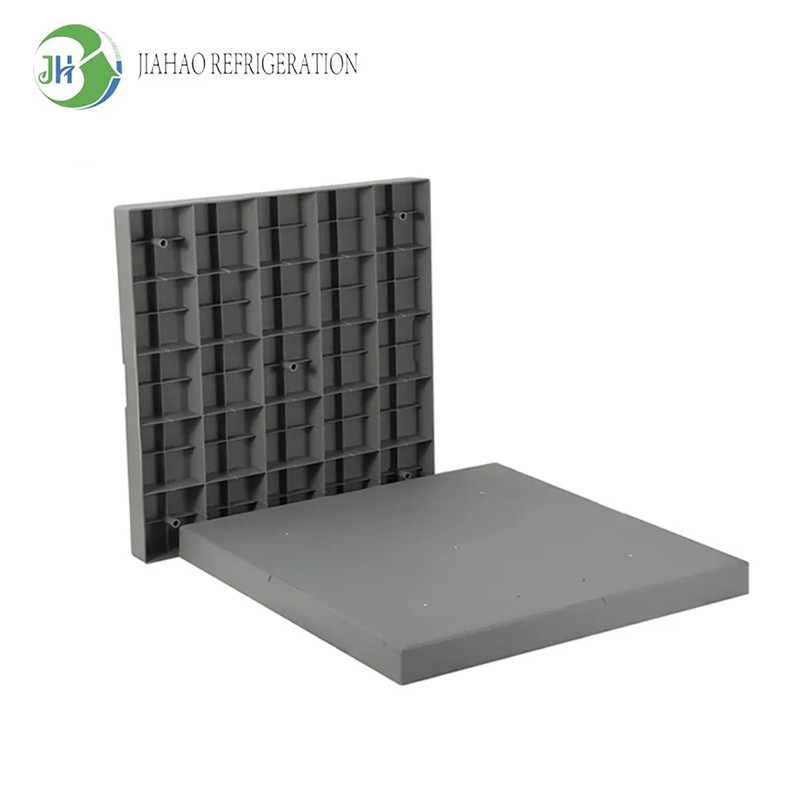
An outdoor HVAC unit gets all the attention — but the pad it sits on faces a relentless chemical assault every single day. Acid rain, coastal salt air, lawn herbicides, and refrigerant oil are all quietly attacking the base beneath the condenser. For concrete pads, this fight ends in crumbling and spalling. For metal frames, it ends in rust. A PP HVAC condenser pad is built to win that fight — and understanding why can save procurement teams significant maintenance cost over the life of a project.
Key Takeaways
Concrete pads react with acid rain and condensate water, causing progressive spalling and structural failure over time.
Metal frames corrode rapidly in coastal salt air and industrial environments, even with protective coatings.
Polypropylene (PP) is chemically inert to the vast majority of outdoor substances — it does not react, absorb moisture, or degrade in these environments.
A PP HVAC condenser pad absorbs less than 0.01% water by mass, eliminating the root mechanism behind most pad failures.
PP pads require zero maintenance and are well-suited to long-warranty engineering projects where lifecycle cost matters most.
The Outdoor Environment: A Constant Chemical Attack on Condenser Pads
The space beneath an outdoor HVAC unit looks quiet — but it is one of the most chemically aggressive micro-environments in a typical building installation. Traditional pad materials are under continuous assault from multiple sources simultaneously.
Acid Rain and Industrial Pollutants
Acid rain is not limited to heavily industrial zones. Even in suburban and semi-rural areas, rainwater routinely carries dissolved sulfur dioxide (SO₂) and nitrogen oxides (NOₓ), giving it a measured pH of 4.2–5.6. According to the U.S. Environmental Protection Agency, these acidic compounds are present across broad geographic regions of North America, Europe, and Asia. When acid rain repeatedly pools on or beneath a concrete condenser pad, it chemically attacks the alkaline calcium compounds in the cement matrix — softening, dissolving, and ultimately crumbling the material from the outside in.
Coastal Salt Air
Coastal installations face an additional, persistent threat: airborne sodium chloride. Salt-laden humidity condenses on cool outdoor surfaces, depositing a saline film that draws in more moisture and dramatically accelerates corrosion in porous or metallic materials. For any metal frame used as a condenser support, this process is self-amplifying — once the chloride ion (Cl⁻) penetrates a protective coating, it forms iron chloride on steel, which in turn breaks down more coating and exposes more fresh metal.
Lawn Chemicals and Fertilizers
Around most residential and commercial HVAC installations, routine lawn maintenance is unavoidable. Nitrogen-based fertilizers and herbicides frequently contact the condenser pad. These compounds contribute to alkalinity erosion in concrete and can accelerate biological growth — moss, lichen, and algae — on porous surfaces. That biological layer retains moisture and deepens chemical damage over time. Metal frames are not immune either: fertilizer salts form electrolytic solutions that accelerate rust formation.
Condensate Water and Compressor Oil
Over the service life of any HVAC system, condensate water dripping from the unit creates a continuous wet-dry cycle that deepens micro-cracks in porous materials. Minor compressor oil seeps — common in aging or high-cycle systems — introduce additional acidity and organic compounds that stain and soften concrete. The combination of these effects means a pad beneath an outdoor condenser ages far faster than one sitting in a neutral, dry environment.
What Happens to Concrete Pads in These Conditions
Concrete performs well under static compressive load, but its fundamental weakness lies in its alkaline, porous structure. The calcium silicate hydrate (CSH) matrix that gives concrete its strength is also the structure that acid attacks. When acidic compounds — whether from rain, condensate water, or fertilizer runoff — repeatedly contact the surface, the CSH matrix is consumed. The result is progressive spalling: the surface softens, flakes, and eventually powders away, reducing structural thickness and load-bearing integrity.
Research on the effects of acid deposition on portland cement concrete structures (documented in publications by the American Chemical Society) confirms that SO₂, NOₓ, and acidic precipitation significantly accelerate the deterioration of concrete and the corrosion of embedded reinforcing steel. In a real-world HVAC installation, this means visible surface damage can appear within 3–7 years in acid-rain-affected regions, with structural cracking following in freeze-thaw climates as absorbed moisture expands on freezing.
Concrete is also heavy (a solid 36"×36"×3" slab weighs approximately 90–145 kg), porous enough to harbour moss and biological growth, and non-recyclable at end of life — adding logistics and disposal costs to its already high maintenance burden.
Why Metal Frames Don't Last Either
Steel and aluminium frame structures used as condenser supports offer good initial strength, but are fundamentally vulnerable to electrochemical corrosion. In coastal environments, the chloride ion from sea salt penetrates paint and galvanizing coatings, initiating a rust cycle that is self-accelerating: iron oxide expands, breaks the coating, and exposes more metal. Studies on steel degradation under simulated acid rain conditions confirm that corrosion rates increase proportionally with acid concentration and exposure duration. In practice, metal frames in coastal or industrial installations often show visible rust penetration within 3–5 years, with structural weakening following shortly after. Recoating and re-treatment extend service life but add recurring cost and require unit downtime.
The Science of PP's Corrosion Resistance
Polypropylene is a semi-crystalline thermoplastic polymer with a non-polar hydrocarbon backbone. That molecular structure is the source of its corrosion resistance: it has no affinity for reaction with most inorganic acids, alkalis, or salts. According to chemical compatibility data published by the Engineering ToolBox, PP achieves an "Excellent — no attack" rating against sulfuric acid (10%), phosphoric acid (25–85%), citric acid, acetic acid (10–75%), calcium hydroxide, caustic soda, and all common neutral salts (including sodium chloride) at ambient temperatures. These are precisely the substances an outdoor PP HVAC condenser pad encounters every day.
Chemical Inertness: No Reaction, No Degradation
Unlike concrete — which actively reacts with acidic compounds — or metal frames — which undergo electrochemical oxidation — PP undergoes no chemical reaction with the outdoor substances described above. Acid rain, sea salt spray, condensate water, lawn herbicides, and refrigerant oil residues simply have no mechanism to attack the polymer chains. A PP HVAC condenser pad does not corrode, spall, swell, or soften under these exposures. The chemical inertness is inherent to the material, not dependent on surface coatings that can wear, chip, or be scratched away.
Near-Zero Water Absorption
PP's water absorption rate is below 0.01% by mass — effectively zero compared to concrete's typical 4–10%. This matters enormously because moisture is the primary transport mechanism for virtually every corrosive substance in an outdoor environment. When a material cannot absorb moisture, acids and salts cannot penetrate its interior. There is no freeze-thaw expansion, no internal chemical reaction, and no progressive structural weakening. A PP HVAC condenser pad remains dimensionally stable through sustained rain, prolonged drought, or repeated freeze-thaw cycles.
UV and Temperature Stability
PP's service temperature range covers continuous use up to approximately 110–125°C, with no deformation at 150°C without external load. Its melting point sits at 164–174°C — well above any temperature a condenser pad would experience outdoors. UV-stabilised PP formulations resist photodegradation from prolonged solar exposure, maintaining surface integrity across a projected service lifespan of 15–25 years. This makes a PP HVAC condenser pad equally suitable for desert heat and northern winters, where temperature extremes accelerate failure in concrete and coated metal.
PP HVAC Condenser Pad vs. Traditional Materials: Performance Comparison
The table below summarises how a PP HVAC condenser pad measures against concrete pads and metal frames across the corrosion scenarios most relevant to outdoor installations. Ratings reflect material performance at ambient outdoor temperatures without special coatings or treatments.
| Performance Factor | PP HVAC Condenser Pad | Concrete Pad | Metal Frame |
|---|---|---|---|
| Resistance to Acid Rain (pH 4–5.5) | Excellent — no reaction | Poor — CSH matrix dissolves over time | Fair — depends on coating integrity |
| Resistance to Coastal Salt Air | Excellent — chloride-inert | Moderate — surface pitting & rebar corrosion | Poor — accelerated rust penetration |
| Resistance to Fertilizers / Herbicides | Excellent — chemically inert | Moderate — alkalinity eroded over time | Fair — coating-dependent |
| Resistance to Condensate & Compressor Oil | Good — no absorption or staining | Poor — porous surface stains and softens | Moderate — surface staining; oil may degrade coating |
| Water Absorption Rate | <0.01% | 4–10% (porous matrix) | Negligible (surface only, coating-protected) |
| Freeze-Thaw Cycle Resistance | Excellent — flexible, no crack propagation | Poor — progressive cracking within 5–10 years | Fair — joints and coatings vulnerable |
| Biological Growth (Moss / Algae) | Minimal — smooth, non-porous surface | High — porous surface retains organic debris | Low to moderate |
| Expected Outdoor Service Lifespan | 15–25 years | 5–20 years (heavily climate-dependent) | 5–10 years in corrosive environments |
| Maintenance Required | None under normal conditions | Crack sealing, periodic replacement | Regular inspection and re-coating |
| Unit Weight (36"×36"×3" class) | ~7.8 kg | ~100–150 kg (solid poured) | ~10–20 kg (typical steel frame) |
Data sources: Engineering ToolBox PP chemical resistance tables; JIAHAO product specifications; standard concrete density (≈2,300 kg/m³); industry outdoor durability studies.
Zero Maintenance: The Real Value for Long-Term Projects
For procurement managers, project engineers, and HVAC contractors working on long-warranty installations, the corrosion resistance of a PP HVAC condenser pad translates directly into reduced lifecycle cost and reduced project risk.
A concrete pad that begins spalling within 5–7 years requires inspection, remediation, or full replacement — adding unplanned cost to any project. A metal frame that develops structural rust in a coastal environment may compromise unit stability and generate warranty disputes. A PP HVAC condenser pad, by contrast, requires no sealing, no painting, no chemical treatment, and no replacement within its typical 15–25 year service window. That "install and forget" characteristic is a genuine procurement advantage.
This zero-maintenance profile is particularly valuable in the following applications:
Engineering projects with 5–15 year warranties — the pad outlasts the warranty period without any planned intervention.
Coastal and industrial installations — where concrete and metal would typically need replacement within 3–7 years.
Large-scale HVAC rollouts — where maintenance cost scales with unit count, making per-unit lifetime savings significant.
Remote or hard-to-access sites — where pad replacement is logistically difficult and operationally disruptive.
The lighter weight of a PP HVAC condenser pad — typically 3–7.8 kg depending on size — also simplifies shipping, reduces installation labour compared to heavyweight concrete alternatives, and lowers total logistics cost on large orders. A full comparison of material performance from an installation and maintenance perspective is available via HVAC Laboratory's technical analysis.
JIAHAO's PP HVAC condenser pads are available in five standard sizes — 18"×38"×3", 24"×24"×3", 30"×30"×2", 32"×32"×3", and 36"×36"×3" — covering the full range of standard residential and light commercial outdoor unit footprints. All sizes carry a 3-year product warranty and are backed by over 50 registered patents in HVAC component manufacturing.
Looking for a Reliable PP HVAC Condenser Pad Manufacturer?
JIAHAO supplies PP HVAC condenser pads to distributors, contractors, and OEM partners worldwide — with 3-year warranty coverage, certified quality, OEM/ODM support, and delivery in 7–15 days (stock) or 20–30 days (custom). Request a quote or product sample today.
Get a Free Quote Now →Summary
Traditional concrete pads and metal frames struggle under the combined chemical assault of acid rain, coastal salt air, lawn chemicals, and refrigerant oil — the everyday reality of outdoor HVAC installation. Concrete spalls as its alkaline cement matrix is dissolved; metal corrodes as chloride ions breach protective coatings. A PP HVAC condenser pad sidesteps all of these failure modes through the inherent chemical inertness and near-zero water absorption of polypropylene. It does not react, does not absorb moisture, does not corrode, and does not biodegrade under outdoor exposure. The result is a pad that performs consistently across its 15–25 year service life with zero maintenance — a genuine advantage for any project where long-term reliability and total cost of ownership are priorities.
Frequently Asked Questions
Q1: Why does a concrete condenser pad crack and spall over time outdoors?
Concrete is alkaline and porous. Acid rain, condensate water, and fertilizer runoff penetrate its surface and react with the calcium compounds in the cement matrix, progressively softening and eroding the material. In climates with freeze-thaw cycles, absorbed moisture expands on freezing, widening micro-cracks and accelerating structural failure. Spalling on outdoor concrete pads can begin within 3–7 years in affected regions.
Q2: Is a PP HVAC condenser pad suitable for coastal or high-salt-air environments?
Yes. Polypropylene is chemically inert to sodium chloride and all common chloride compounds. A PP HVAC condenser pad shows no corrosion, swelling, surface pitting, or structural degradation even after years of continuous exposure to salt-laden coastal air — making it the preferred choice for seaside and marine installations.
Q3: Can lawn herbicides or fertilizers damage a PP HVAC condenser pad?
No. PP has excellent resistance to nitrogen-based fertilizers and most common herbicide formulations at ambient outdoor temperatures. These substances do not corrode, stain, or weaken a PP HVAC condenser pad. This is in contrast to concrete, where fertilizer salts contribute to surface erosion and biological growth over time.
Q4: How long does a PP HVAC condenser pad typically last in service?
When installed on a stable, level base and loaded within its rated capacity, a quality PP HVAC condenser pad typically delivers 15–25 years of service life without needing replacement, repair, or surface treatment. This compares favourably to concrete, which may require replacement within 5–10 years in harsh climates, and to metal frames that can corrode through in as little as 3–7 years in coastal environments.
Q5: Does a PP HVAC condenser pad require any maintenance after installation?
Minimal to none under normal outdoor conditions. PP does not rust, absorb moisture, or biodegrade. A periodic visual check to confirm the pad remains level and is clear of accumulated debris is all that is typically needed — no sealing, painting, re-coating, or chemical treatment required. This zero-maintenance characteristic is one of the primary reasons PP pads are preferred for long-warranty engineering projects.
Q6: What sizes of PP HVAC condenser pads does JIAHAO supply?
JIAHAO manufactures PP HVAC condenser pads in five standard sizes: 18"×38"×3" (3.6 kg), 24"×24"×3" (3 kg), 30"×30"×2" (5.8 kg), 32"×32"×3" (6.3 kg), and 36"×36"×3" (7.8 kg). Custom dimensions are also available to OEM and project-specific specifications, with delivery timelines of 20–30 days for custom production and 7–15 days for stock sizes.


