



Complete Guide To HVAC Refrigerant Line Insulation: Professional Installation Made Simple
 Oct 17, 2025|
 View:117
Properly insulated air conditioner connection pipes form the foundation of an efficient HVAC system. Whether installing a new system or replacing worn insulation, understanding the correct installation techniques ensures optimal performance and energy savings. This comprehensive guide walks through every step of the refrigerant line insulation process, from material selection to final inspection.
Key Takeaways
- Proper insulation on air conditioner lines reduces energy consumption by 5-15% and extends equipment lifespan
- Only the suction line (larger, cold pipe) requires insulation; the liquid line should remain exposed
- Closed-cell foam materials provide the best moisture resistance for insulated copper pipe applications
- Correct sizing is critical—insulation must fit snugly without compression or gaps
- Complete sealing at all joints, slits, and penetrations prevents moisture infiltration and heat transfer
- UV protection extends outdoor insulation life from 5 years to 15+ years in sunny climates
- Annual inspection identifies damage early, preventing efficiency loss and costly repairs
Why HVAC Refrigerant Line Insulation Matters
Understanding the Refrigerant Line System
Every air conditioning system contains two refrigerant lines connecting the indoor evaporator to the outdoor condenser. The smaller liquid line carries hot, high-pressure refrigerant and releases heat naturally through the copper—it does not need insulation. The larger suction line carries cold refrigerant vapor and requires complete insulation to maintain efficiency.
Without proper insulation on the suction line, warm ambient air heats the refrigerant before it reaches the compressor. This heat gain forces the compressor to work harder, increasing energy consumption by 10-15% and accelerating wear on system components.
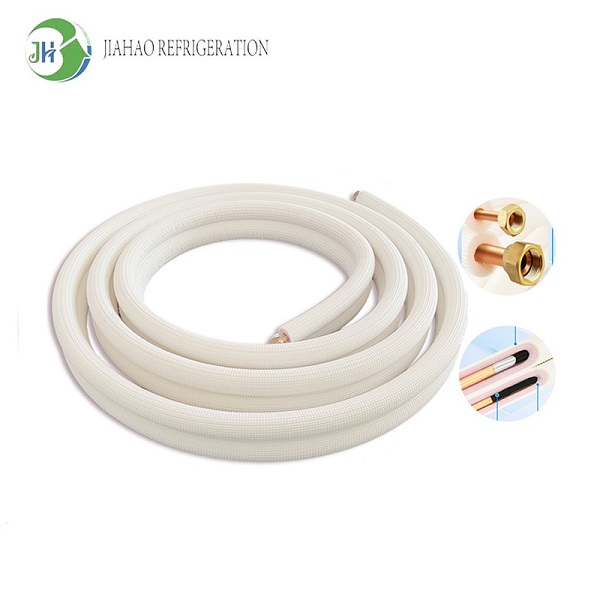
Energy Efficiency and Cost Savings
Insulated air conditioner connection pipes deliver measurable benefits, with energy savings documented at 5-15% according to mechanical insulation studies. Proper insulation extends compressor lifespan by 2-4 years while maintaining full rated cooling capacity:
| Benefit | Impact |
Energy Savings | 5-15% reduction in cooling costs |
Compressor Lifespan | 2-4 years extended service life |
Cooling Capacity | Maintains full rated performance |
Condensation Prevention | Eliminates water damage to structures |
Return on Investment | 2-3 year payback on material costs |
Protection Against Damage
Quality insulation protects air conditioner lines from multiple environmental threats. UV degradation causes copper oxidation and material breakdown, while physical damage from lawn equipment, animals, and weather can compromise system integrity. Condensation without proper insulation damages walls, ceilings, and building insulation, and temperature extremes stress both refrigerant and system components. These protective functions become particularly critical in harsh climates where uninsulated pipes face accelerated deterioration.
Selecting the Right Insulation Materials
Material Types and Performance
Three main materials dominate the market for insulating air conditioner connection pipes. Each offers distinct advantages for specific applications:
Polyethylene Foam (Most Common)
- R-value: 3.6-4.2 per inch
- Temperature range: -40°F to 220°F
- Cost: Most economical option
- Best for: Residential applications, indoor installations
- Lifespan: 10-15 years outdoors, 15-20 years indoors
Elastomeric Rubber (Premium)
- R-value: 4.0-4.5 per inch
- Temperature range: -40°F to 220°F
- Cost: 40-60% higher than polyethylene
- Best for: Commercial systems, harsh climates, long line runs
- Lifespan: 15-20 years outdoors, 20-25 years indoors
Fiberglass (Industrial)
- R-value: 4.0-4.3 per inch
- Requires separate vapor barrier
- Best for: Large commercial/industrial systems
- More complex installation
Closed-cell foam construction is essential for all insulated copper pipe applications, as recommended by ASHRAE for refrigeration systems. Open-cell materials absorb moisture and lose their insulating properties rapidly, making them unsuitable for refrigerant line protection.
Sizing Requirements
Insulation must match the copper pipe diameter exactly to perform effectively. Proper sizing ensures thermal efficiency and prevents condensation:
| Copper Pipe Size | Common Application | Insulation ID Required |
1/4" | Small system liquid line | 1/4" |
3/8" | Standard liquid line | 3/8" |
1/2" | Small system suction line | 1/2" |
5/8" | Standard suction line | 5/8" |
3/4" | Large system suction line | 3/4" |
7/8" | Very large system suction | 7/8" |
Insulation thickness depends on climate zone and local building codes. According to ASHRAE 90.1 standards, minimum requirements are:
- Hot climates: 3/8" to 1/2" minimum
- Moderate climates: 1/2" to 5/8" recommended
- Cold climates: 5/8" to 3/4" for best performance
Pre-slit vs. Non-slit Options
Pre-slit insulation includes a built-in adhesive strip for easy sealing, offering faster installation and better results for beginners at slightly higher cost. The integrated sealing system reduces installation time and minimizes potential errors during the sealing process.
Non-slit insulation requires manual slitting or tape sealing but provides superior moisture protection when properly installed. Professional installers often prefer non-slit options for the lower material cost and better long-term performance. While requiring more skill to install, the manual sealing approach allows for more precise control over joint integrity.
How to Insulate Air Conditioner Copper Pipe: Step-by-Step Guide
Preparation Phase
Successful installation begins with proper preparation and safety measures. Gather all necessary materials before starting work:
Tools and Materials Needed:
- Insulation sleeves (measured to pipe size)
- Sharp utility knife with fresh blades
- Measuring tape or ruler
- Electrical or vinyl tape
- UV-resistant tape (for outdoor sections)
- Weatherproof foam sealant
- Zip ties or cable ties
- Clean cloths
- Isopropyl alcohol (for cleaning)
- Safety glasses and gloves
Turn off the air conditioning system completely and wait at least 30 minutes for refrigerant lines to reach ambient temperature. Working on cold pipes causes immediate condensation that becomes trapped inside new insulation, leading to mold growth and corrosion problems. When accessing elevated sections, always work from a stable ladder and maintain proper safety protocols.
Step 1: Remove Existing Insulation
For replacement installations, careful removal prevents copper pipe damage and reveals any underlying problems. Use a sharp utility knife to slice along the length of old insulation, cutting on the underside or least visible area of the pipe. Carefully pull the old insulation away from the copper, working slowly to avoid nicking the pipe surface.
Inspect the exposed copper thoroughly for these critical issues:
- Green oxidation or corrosion
- Oil stains indicating refrigerant leaks
- Dents, kinks, or physical damage
- Loose fittings or connections
Wipe the copper pipe thoroughly with a clean, dry cloth, removing all adhesive residue, dirt, and debris. For stubborn residue, use isopropyl alcohol on a cloth, then dry the surface completely. If the suction line feels cold or shows moisture, wait longer for it to warm before proceeding. If you discover any refrigerant leaks or damage during inspection, contact a licensed HVAC technician for repairs before installing new insulation.
Step 2: Measure and Cut Insulation
Accurate measurements ensure professional results and complete coverage. Use calipers or measuring tape to confirm the exact outside diameter of your copper pipe, then compare this to insulation product specifications.
Measure each section of refrigerant line requiring insulation separately: indoor vertical drops, horizontal runs through walls or attics, and outdoor sections to the condenser unit. Add 10% extra for thermal expansion and cutting waste. Rather than cutting all pieces at once, measure and cut each section individually to accommodate variations in pipe routing.
Place insulation on a clean, flat surface, measure the required length plus 1/2 inch, and use a sharp utility knife to make clean, perpendicular cuts. Avoid sawing motions that compress the foam structure. For corners and bends, cut separate pieces for each straight section rather than trying to bend long pieces around corners. Miter-cut ends at 45-degree angles for elbow fittings, or use pre-formed elbow covers for complex bends.
Step 3: Install Insulation on Straight Runs
Proper installation technique ensures optimal insulation performance throughout the system's lifespan.
For Pre-slit Insulation:
Gently pull apart the pre-cut slit to open the insulation sleeve, then wrap it around the air conditioner connection pipe ensuring complete coverage with no exposed copper. Position the slit on the bottom or least visible side of the pipe, ensuring edges meet evenly along the entire length.
Remove the protective backing from the adhesive strip and press the edges together firmly, starting at one end and working toward the other. Apply consistent pressure along the entire seam to eliminate gaps. Run your hand along the insulation to ensure complete contact with the pipe surface, pressing out any air pockets or bulges.
For Non-slit Insulation:
Create a straight lengthwise cut through one side to the center hollow if not pre-slit. Open the cut and wrap the insulation around the copper pipe. Apply specialized insulation tape or electrical tape along the slit, starting at one end and spiraling toward the other. Overlap each wrap by 50% of the tape width and press firmly to create a complete seal with no gaps in coverage.
Step 4: Connect and Seal Joints
Where two insulation pieces meet, proper sealing prevents moisture infiltration and maintains thermal efficiency. This step is critical for long-term performance:
- Position the ends of adjacent insulation pieces as close together as possible with zero gap
- Start taping 2 inches before the joint on the first piece
- Wrap in a spiral pattern with 50% overlap
- Continue 2 inches past the joint onto the second piece
- Use 4-6 wraps of tape across the joint area
- Press firmly to eliminate air pockets and ensure a waterproof seal
Visually verify that no gaps or exposed copper remain at any connection point. This attention to detail at joints often determines the difference between professional-grade installation and amateur work that fails prematurely.
Step 5: Insulate Elbows and Bends
Corners require special attention to maintain complete coverage without gaps. The installation approach depends on the bend complexity and available materials.
Miter-Cut Technique:Cut insulation ends at 45-degree angles matching the bend angle, fit the angled pieces together at the elbow, ensure no exposed copper remains, and tape all edges thoroughly to create a continuous thermal barrier.
Pre-formed Elbow Covers:Install straight insulation up to 1 inch from the elbow fitting, slide the pre-formed cover over the elbow, overlap with straight sections by 1 inch, and tape all connections securely.
Tight Radius Bends:Use shorter insulation segments (3-4 inches), carefully fit each piece around the curve, seal every joint with extra tape, and verify no gaps exist along the bend.
Step 6: Seal Wall Penetrations
Where air conditioner lines enter buildings, thorough sealing prevents air and moisture infiltration that defeats insulation effectiveness. This critical transition point requires careful attention to detail.
Extend insulation completely through the wall thickness to the interior side, leaving no gaps in coverage. Apply weatherproof expanding foam sealant around the insulated pipes, filling completely but avoiding over-expansion that could compress pipes. Allow foam to cure per manufacturer instructions, then trim excess foam flush with the wall surface.
Install exterior flashing or drip cap above the penetration, sloping away from the building to shed water. Seal flashing to wall with weatherproof caulk. On the interior side, install escutcheon plates or wall sleeves for a clean appearance, sealing any gaps between plate and wall to ensure no exposed copper remains visible.
Step 7: Protect Outdoor Sections
Outdoor insulation requires additional UV and weather protection to achieve its rated lifespan. Without proper protection, standard foam materials degrade rapidly under sun exposure.
Starting at the wall penetration, spiral UV-resistant tape over the entire outdoor insulation length, maintaining 50% overlap between wraps. Extend coverage to the service valve at the condenser unit and press firmly to ensure adhesion. This protective layer extends insulation life from 3-5 years to 10-15 years in sunny climates.
Alternatively, slide split PVC pipe covers over the insulated lines for maximum protection in harsh climates. Secure with UV-resistant zip ties every 18-24 inches and seal ends with weatherproof tape or caps. Use additional zip ties to prevent sagging or movement, spacing fasteners every 2-3 feet on horizontal runs and supporting vertical runs every 4-6 feet.
Step 8: Final Inspection and Testing
A thorough inspection ensures the installation will perform as intended for years to come. Systematic verification catches potential problems before they cause efficiency loss.
Visual Inspection Checklist:
- All copper pipe surfaces completely covered with insulation
- No gaps between insulation pieces
- All slits fully sealed with adhesive or tape
- Joints properly taped with 2-inch overlap minimum
- Elbows and bends completely insulated
- Wall penetrations sealed against weather
- Outdoor sections protected with UV-resistant covering
- Insulation secured and won't sag or shift
- No compressed or damaged areas
Operational Testing:
Turn on the air conditioning system and allow it to run for 30-60 minutes to reach normal operating temperature and pressure. Feel the insulated suction line—it should not feel cold to the touch through the insulation. If it feels cold, the insulation is too thin or improperly installed.
Inspect all insulated sections for moisture on the exterior surface. Any condensation indicates gaps in coverage, insufficient insulation thickness, moisture trapped during installation, or poor sealing at joints. Verify that indoor air reaches the set temperature, listen for normal compressor operation without excessive cycling, confirm adequate airflow from vents, and ensure no ice formation appears on the indoor coil.
Common Installation Mistakes and How to Avoid Them
Mistake #1: Incorrect Insulation Sizing
Undersized insulation stretches during installation, compressing the foam structure and reducing R-value by 30-50%. Oversized insulation fits loosely, allowing air circulation that eliminates insulating effectiveness.
How to Avoid:Measure copper pipe diameter precisely with calipers, select insulation with inside diameter matching pipe size exactly, test fit a small piece before purchasing large quantities, and consult sizing charts from manufacturers like JIAHAO for proper specifications.
Mistake #2: Inadequate Joint Sealing
Gaps at joints between insulation pieces create pathways for heat transfer and moisture infiltration. Even small gaps dramatically reduce overall insulation performance and can lead to condensation problems.
How to Avoid:Butt insulation pieces together with zero gap, wrap joints with tape extending 2 inches on each side, use 50% tape overlap to ensure complete coverage, and double-check every joint visually before moving to the next section.
Mistake #3: Skipping UV Protection
Standard foam insulation degrades rapidly under UV exposure. In sunny climates, unprotected outdoor insulation becomes brittle and cracks within 2-3 years instead of lasting 10-15 years.
How to Avoid:Always wrap outdoor sections with UV-resistant tape, consider PVC jacketing for maximum protection, select insulation products with built-in UV inhibitors, and reapply UV protection every 3-5 years.
Mistake #4: Installing Over Wet Pipe
Installing insulation over a cold, condensation-covered suction line traps moisture inside. This trapped moisture promotes copper corrosion and allows mold growth that compromises air quality and system integrity.
How to Avoid:Turn off AC system 30+ minutes before starting work, wipe pipes thoroughly and verify they're dry to touch, install on warm dry days when possible, and never rush installation when condensation persists.
Mistake #5: Poor Wall Penetration Sealing
Unsealed gaps at wall penetrations allow air infiltration, moisture intrusion, and pest entry. This defeats the purpose of insulation and can cause structural damage over time.
How to Avoid:Extend insulation completely through wall thickness, fill all gaps with weatherproof foam sealant, install flashing or drip caps on exterior side, use escutcheon plates for finished interior appearance, and inspect penetrations annually for re-sealing needs.
Mistake #6: Insulating the Wrong Line
Some installers insulate the liquid line (smaller, hot pipe) by mistake. This actually reduces system efficiency by preventing necessary heat dissipation from the refrigerant.
How to Avoid:Identify lines correctly—suction line is larger and cold to touch—only insulate the suction line (cold vapor line), leave liquid line exposed unless manufacturer specifies otherwise, and when in doubt, consult system documentation or an HVAC professional.
Maintenance and Inspection Guidelines
Annual Inspection Schedule
Regular inspection keeps air conditioner connection pipes functioning efficiently throughout their service life.
Spring Pre-Season Inspection (Before Cooling Season):Remove debris and dirt from outdoor insulation, check for winter damage including cracks, splits, and animal damage, verify tape and seals remain intact, look for signs of moisture or mold, test insulation for brittleness or hardening, and repair or replace any damaged sections.
Fall Post-Season Inspection (After Cooling Season):Assess UV damage to outdoor sections, check for condensation stains on indoor insulation, inspect wall penetrations for seal integrity, document any deterioration for winter repair planning, and identify replacement needs for the following season.
Monthly Quick Checks During Operating Season:Visual scan of accessible sections during AC use, look for obvious damage or deterioration, watch for condensation on insulation surface, and note any changes in system performance.
Signs Requiring Immediate Attention
Contact an HVAC professional or plan repairs when you notice physical damage such as cracks, splits, holes in insulation material, exposed copper pipe sections, compressed or crushed areas, missing or torn UV protective covering, or damage from animals or lawn equipment.
Moisture problems demand urgent attention: condensation forming on insulation exterior, wet or damp insulation that doesn't dry, water stains on walls or ceilings near refrigerant lines, mold or mildew growth on insulation, or ice buildup on outdoor sections during operation.
Performance issues may indicate insulation failure: higher than normal electricity bills, longer run times to reach set temperature, reduced cooling capacity, frost on indoor evaporator coil, or frequent compressor cycling.
Repair vs. Replacement Decision Guide
| Situation | Action | Timeline |
Small tear or hole (< 2 inches) | Repair with patch and tape | Within 1 week |
Damaged section (< 3 feet) | Replace affected section | Within 2 weeks |
Multiple damaged areas | Replace entire line set | Within 1 month |
UV degradation (brittle, cracking) | Replace all outdoor insulation | Before next season |
Persistent condensation issues | Replace with thicker insulation | Immediately |
Material over 15 years old | Plan complete replacement | Within 1-2 years |
More than 30% shows deterioration | Replace entire system | Within 1 season |
Extending Insulation Lifespan
Proactive maintenance adds years to insulation life and maintains system efficiency. Reapply UV-resistant tape or coating to outdoor sections every 3-5 years to prevent sun damage. Install conduit guards in high-traffic areas and keep vegetation trimmed at least 12 inches from refrigerant lines to prevent physical damage.
Gently brush dust and dirt from insulation annually, but never use pressure washers or harsh chemicals that can damage the foam structure. Ensure water drains away from outdoor units and wall penetrations by grading soil to prevent standing water accumulation. Check that zip ties and fasteners remain tight, replacing any that have degraded from UV exposure. Have an HVAC technician inspect refrigerant lines every 3-5 years during routine system maintenance for comprehensive evaluation.
Selecting Quality Materials and Manufacturers
What to Look for in Insulation Products
Quality insulation products exhibit specific characteristics that indicate reliable performance:
Material Quality Indicators:
- Uniform closed-cell structure throughout
- Consistent color without streaking
- No manufacturing defects, tears, or gaps
- Precise dimensions matching specifications
- Clean, straight edges on pre-slit products
- Strong, reliable adhesive on pre-slit seams
- Clear product labeling and specifications
Performance Documentation:
- Published R-value per inch thickness
- Moisture vapor transmission rates
- Operating temperature range
- UV resistance ratings for outdoor use
- Fire resistance certifications
- Warranty coverage and duration
Why Choose Professional AC Pipe Manufacturers
Established ac pipe manufacturers provide significant advantages over generic suppliers. Companies like JIAHAO focus exclusively on air conditioner connection pipes and insulated copper pipe products, ensuring engineering specifically for HVAC applications rather than adapted general-purpose materials.
Professional manufacturers implement rigorous quality assurance throughout production: pressure testing of copper pipes, leak detection verification, insulation adhesion testing, dimensional accuracy checks, and material composition verification. They maintain comprehensive product ranges covering all standard pipe diameters from 1/4" to 1-1/8", multiple insulation thicknesses, pre-insulated line set assemblies, individual components for custom installations, and compatible fittings and accessories.
Technical support provides installation guidance, product selection assistance, and troubleshooting help that ensures successful installations. Reliable manufacturers maintain stock of all standard sizes, eliminating costly delays from backorders or material shortages.
JIAHAO Manufacturing Advantages
For professionals and homeowners seeking reliable air conditioner lines, JIAHAO offers several key advantages that ensure long-term performance.
With over 10 automated production lines and 25,000 square meters of manufacturing space, JIAHAO maintains consistent quality and reliable supply chains. Premium copper meeting international purity standards ensures excellent thermal conductivity and corrosion resistance, while insulation materials feature closed-cell construction with UV-resistant formulations for extended outdoor life.
Every product undergoes comprehensive testing including pressure verification, leak detection, and dimensional inspection before shipping. Continuous improvement based on field performance and customer feedback results in enhanced products like improved R32 refrigerant-compatible line sets and easier installation features. Professional support includes technical documentation, sizing charts, and customer service to ensure proper product selection and successful installation.
Climate-Specific Installation Considerations
Hot and Humid Climates
High ambient temperatures and humidity create unique challenges for air conditioner connection pipes that require specialized approaches.
Use minimum 5/8" thick insulation (3/4" preferred) to combat higher temperature differentials. Thicker insulation prevents condensation more effectively in humid conditions where the temperature difference between refrigerant and ambient air is greatest.
Select materials with lowest moisture vapor transmission rates—elastomeric rubber performs better than polyethylene in high-humidity environments. Always install UV-resistant wrap or PVC jacketing on outdoor sections, as intense sunlight degrades insulation rapidly. Expect to reapply UV protection every 3-4 years instead of 5+ years in moderate climates.
Pay extra attention to indoor sections in attics and crawl spaces where humidity accumulates. Ensure complete sealing at all joints and penetrations to prevent moisture infiltration that leads to mold growth and efficiency loss.
Cold Climates
Extreme cold creates different installation requirements and material behavior considerations.
Insulation materials become stiff and difficult to work with below 50°F, so plan installations for warmer days or pre-warm materials indoors before use. Ensure outdoor sections have adequate UV and moisture protection to prevent ice damage—water infiltration that freezes can crack insulation from inside.
Temperature swings from -20°F to 100°F cause significant pipe expansion and contraction. Leave extra space at joints and use flexible adhesives to accommodate this thermal movement. Heat pump systems may require insulation on both refrigerant lines since they reverse refrigerant flow, so consult system documentation for specific requirements.
Coastal Environments
Salt air and high winds present unique challenges for insulated copper pipe installations in oceanside locations.
Salt accelerates copper corrosion, so ensure complete insulation coverage with no exposed copper. Consider copper pipes with extra corrosion-resistant coating for maximum longevity. Secure outdoor insulation every 18-24 inches instead of standard 36-48 inches to resist wind forces, and use stainless steel zip ties that won't corrode in salty conditions.
Select elastomeric insulation with built-in vapor barrier to combat extreme coastal humidity. Inspect more frequently—every 6 months—for moisture infiltration and apply marine-grade UV-resistant coatings for maximum protection. Consider rigid PVC conduit for outdoor sections to provide complete protection against the harsh coastal environment.
Conclusion
Proper installation of HVAC refrigerant line insulation delivers significant benefits in energy efficiency, system longevity, and reliable performance. By following the step-by-step procedures outlined in this guide, homeowners and HVAC professionals can achieve professional-quality results that last for years.
Success requires selecting appropriate materials for your climate and application, measuring and sizing insulation accurately, installing with attention to detail at joints, bends, and penetrations, protecting outdoor sections from UV and weather damage, and conducting regular inspections with timely maintenance.
Whether installing a new system or replacing worn insulation on existing air conditioner lines, using quality materials from professional ac pipe manufacturers ensures reliable long-term performance. Companies like JIAHAO provide the specialized expertise, quality assurance, and technical support needed for successful HVAC installations. Invest the time to install refrigerant line insulation correctly, and your air conditioning system will reward you with lower energy bills, improved comfort, and extended equipment life for many years to come.
Frequently Asked Questions
Q: Do I need to insulate both refrigerant lines?
No. Only insulate the larger suction line (cold vapor line). The smaller liquid line should remain exposed because it needs to dissipate heat. Insulating the liquid line reduces system efficiency by interfering with necessary heat rejection.
Q: How thick should insulation be for my climate?
Minimum recommendations by climate zone are 5/8" to 3/4" for hot and humid climates, 1/2" to 5/8" for moderate climates, and 1/2" minimum for cold climates. Always check local building codes, which may require thicker insulation than these general minimums.
Q: Can I use pipe insulation from the plumbing section at hardware stores?
While similar in appearance, plumbing pipe insulation may lack the UV resistance, moisture barriers, and temperature ratings needed for HVAC applications. Use insulation specifically designed for air conditioner connection pipes to ensure proper performance and longevity.
Q: How often should refrigerant line insulation be replaced?
With quality materials and proper installation, indoor insulation lasts 15-20 years, outdoor insulation with UV protection lasts 10-15 years, and outdoor insulation without protection only lasts 3-5 years. Replace sooner if damage, brittleness, or persistent condensation occurs.
Q: Why is condensation forming on my newly installed insulation?
Common causes include gaps or unsealed joints in insulation, insulation too thin for climate conditions, moisture trapped during installation, compromised vapor barrier, or refrigerant charge issues requiring professional service. Inspect joints and sealing thoroughly first.
Q: Can I install insulation while the AC is running?
No. Turn off the system for 30+ minutes before installation. Working on cold pipes causes immediate condensation that gets trapped inside new insulation, leading to mold and corrosion problems that compromise system integrity.
Q: What's the best type of tape for sealing insulation joints?
Use specialized insulation tape or high-quality electrical/vinyl tape rated for outdoor use. For outdoor sections, UV-resistant PVC tape provides best longevity and adhesion. Standard masking tape or duct tape degrades quickly and should not be used.
Q: Do I need a permit to replace refrigerant line insulation?
Replacing insulation typically doesn't require a permit since you're not modifying the refrigerant system. However, if installing new refrigerant lines or making connections, permits may be required. Check with your local building department for specific requirements.
Q: Should I hire a professional or do it myself?
DIY installation is feasible for homeowners with basic skills and proper tools. Consider hiring a professional if refrigerant lines are difficult to access (high walls, tight spaces), the system shows signs of refrigerant leaks, you're uncomfortable working with HVAC equipment, or local codes require licensed installation.
Q: Where can I purchase quality insulation materials?
Professional-grade insulated copper pipe and air conditioner connection pipes are available from HVAC supply distributors, specialized ac pipe manufacturers like JIAHAO, online HVAC parts suppliers, and some well-stocked home improvement centers. Avoid generic "pipe insulation" and specify HVAC refrigerant line insulation for best results.


