



Comparing Copper Line Sets For Mini-split Vs Central AC Systems
 Aug 27, 2026|
 View:54
A copper line set is the pair of refrigerant pipes that connects an outdoor condenser to an indoor air handler or evaporator coil. It carries liquid refrigerant to the indoor unit and returns low-pressure gas to the outdoor compressor. Despite performing the same basic function in every split-type air conditioner, the copper line set specifications for mini-split systems and central AC systems differ substantially in diameter, insulation, connection method, and installation practice.
Choosing the wrong AC copper pipe diameter causes measurable efficiency loss, reduced cooling capacity, and premature compressor failure. This guide compares copper line sets for mini-split and central AC systems across every technical dimension that matters to installers, contractors, and project buyers. All sizing references are general guidelines — the equipment manufacturer's installation manual always takes precedence.
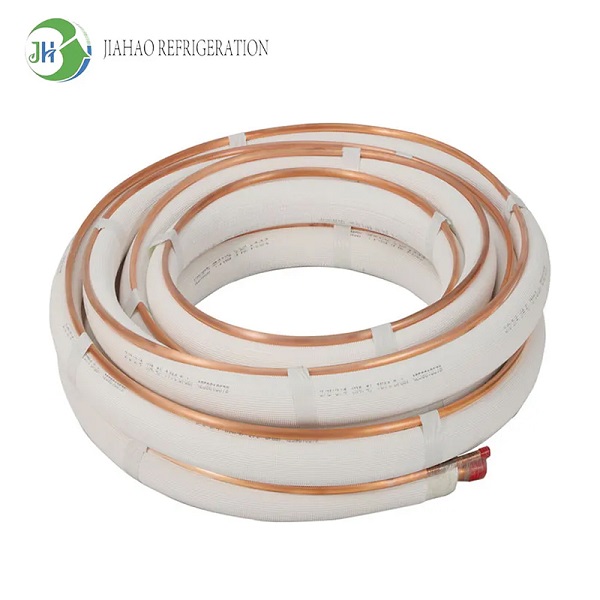
Mini-split copper line sets use smaller diameters (1/4"–5/8") and come pre-insulated as paired coils.
Central AC systems require larger AC copper pipe (3/8"–1-1/8") to move greater refrigerant volume.
Only the suction line needs insulation; the liquid line typically does not.
Mini-splits usually use flare connections; central AC often uses brazed joints for larger pipe.
Line length beyond the manufacturer's limit requires added refrigerant and possibly larger diameter.
Always match pipe size to the equipment rating — oversizing or undersizing both hurt efficiency.
ASTM B280 compliant copper tube is the industry baseline for refrigerant piping.
Line Set Range
Pipe Range
Tube Standard
Purity (TP2)
What Is a Copper Line Set and How Does It Work?
Every split-system air conditioner relies on a copper line set to circulate refrigerant between the outdoor and indoor units. The set consists of two tubes of different diameters:
Liquid line — the smaller tube, carrying high-pressure, high-temperature liquid refrigerant from the condenser to the indoor expansion device.
Suction line — the larger tube, carrying low-pressure, low-temperature refrigerant vapor from the evaporator back to the compressor.
The suction line is always insulated to prevent condensation and minimize heat gain from the surrounding air. The liquid line is generally left uninsulated because its surface temperature is above the dew point in most operating conditions. The two tubes are often bundled together with a single insulation sleeve covering the suction line, a configuration commonly sold as a pre-insulated copper line set.
AC copper pipe for refrigerant service is typically made from phosphorus-deoxidized copper (TP2 / C12200), with a minimum copper content of 99.9%. This alloy offers excellent thermal conductivity, corrosion resistance, and formability — properties that make copper the dominant material for refrigerant piping worldwide. The widely referenced material standard for this application is ASTM B280, which covers seamless copper tube for air conditioning and refrigeration field service.
Mini-Split vs Central AC: Core Differences at a Glance
While both system types use copper line sets, their design constraints produce different pipe specifications. Mini-split systems are typically single-zone or multi-zone ductless units with lower cooling capacity, while central AC systems serve ducted whole-house applications with higher tonnage. The table below summarizes the principal differences.
| Parameter | Mini-Split AC | Central AC (Split System) |
|---|---|---|
| Typical Capacity | 9,000 – 36,000 BTU (0.75 – 3 tons) | 18,000 – 60,000 BTU (1.5 – 5 tons) |
| Liquid Line OD | 1/4" (6.35 mm) most common; 3/8" for larger units | 3/8" (9.52 mm) to 1/2" (12.7 mm) |
| Suction Line OD | 3/8" (9.52 mm) to 5/8" (15.88 mm) | 3/4" (19.05 mm) to 1-1/8" (28.6 mm) |
| Supply Format | Pre-insulated paired coils (10 ft, 16 ft, 25 ft, 50 ft) | Separate straight lengths or coils, field-cut to size |
| Connection Method | Flare fittings (pre-charged systems) | Brazed joints (most common); flare on some units |
| Refrigerant Charge | Factory pre-charged for standard length; field-adjust for extensions | Often field-charged by weight after evacuation |
| Typical Max Line Length | 25 – 80 ft (varies by model) | 50 – 100+ ft (with diameter adjustments) |
| Insulation Thickness | 3/8" – 1/2" (9.5 – 12.7 mm) rubber foam | 1/2" – 3/4" (12.7 – 19 mm) for larger suction lines |
Diameter Sizing: Matching Pipe to Cooling Capacity
The single most important specification for any copper line set is the tube diameter. Pipe size is determined by the system's cooling capacity and the refrigerant type. Undersized pipe creates excessive pressure drop, reducing capacity and raising compressor discharge temperature. Oversized pipe increases refrigerant charge, slows oil return, and raises material cost. The correct diameter sits at the intersection of acceptable pressure drop and adequate oil-return velocity.
Mini-Split Copper Line Set Sizing
Mini-split systems operate at lower capacity and therefore use smaller AC copper pipe. The most common mini-split copper line set is 1/4-inch liquid paired with 3/8-inch suction, suitable for units up to approximately 18,000 BTU. As capacity increases, the suction line diameter grows while the liquid line often stays at 1/4 inch.
| Capacity (BTU) | Liquid Line OD | Suction Line OD | Typical Application |
|---|---|---|---|
| 9,000 – 12,000 | 1/4" (6.35 mm) | 3/8" (9.52 mm) | Single-room ductless |
| 18,000 – 24,000 | 1/4" (6.35 mm) | 1/2" (12.7 mm) | Large room / light commercial |
| 30,000 – 36,000 | 3/8" (9.52 mm) | 5/8" (15.88 mm) | Multi-zone / small commercial |
| 42,000 – 48,000 | 3/8" (9.52 mm) | 3/4" (19.05 mm) | Light commercial rooftop |
Note: Sizes are general ranges for R410A/R32 systems. Always verify against the specific manufacturer's installation manual, as requirements vary by brand and model.
Central AC Copper Pipe Sizing
Central split systems move a larger volume of refrigerant and therefore require larger diameter pipe. A typical 3-ton residential central AC uses a 3/8-inch liquid line and 3/4-inch suction line. At 4 to 5 tons, the suction line increases to 7/8 inch or 1-1/8 inch. The liquid line diameter changes less frequently because liquid refrigerant is dense and requires a smaller cross-sectional area for the same mass flow rate.
| Capacity (Tons / BTU) | Liquid Line OD | Suction Line OD | Typical Application |
|---|---|---|---|
| 1.5 – 2 tons (18k–24k) | 3/8" (9.52 mm) | 5/8" – 3/4" (15.9–19.1 mm) | Small home ducted |
| 2.5 – 3 tons (30k–36k) | 3/8" (9.52 mm) | 3/4" (19.05 mm) | Average home ducted |
| 3.5 – 4 tons (42k–48k) | 3/8" – 1/2" (9.5–12.7 mm) | 7/8" (22.2 mm) | Large home / light commercial |
| 5 tons (60k) | 1/2" (12.7 mm) | 1-1/8" (28.6 mm) | Large home / commercial |
Note: Sizes are general ranges for R410A residential split systems. Actual sizing depends on line length, elevation difference, and manufacturer specifications. For line sets exceeding 50 feet, consult the manufacturer's long-line set guidelines.
Insulation Requirements for Copper Line Sets
Insulation serves two purposes on a copper line set: it prevents condensation on the cold suction line, and it reduces unwanted heat gain that would reduce system efficiency. The insulation material is typically closed-cell rubber foam with a thermal conductivity not exceeding approximately 0.034 W/m·K at 0°C. This material is flexible, resistant to water vapor transmission, and suitable for the temperature range encountered in AC refrigerant piping.
Which Line Gets Insulated?
Only the suction line requires insulation in standard installations. The suction line carries cold, low-pressure vapor at temperatures typically between 35°F and 55°F (2°C–13°C). Without insulation, moisture from the ambient air condenses on the pipe surface, causing water damage and corrosion. The liquid line, by contrast, carries warm high-pressure liquid and does not condense moisture under normal conditions. Insulating the liquid line is generally unnecessary and can trap moisture against the pipe surface.
Insulation Thickness by Pipe Size
Required insulation thickness increases with pipe diameter because larger pipes have more surface area and greater heat gain potential. The following thicknesses are commonly specified in residential and light commercial installations:
| Copper Pipe OD | Minimum Insulation Thickness | Common in Which System |
|---|---|---|
| Up to 1/2" (12.7 mm) | 3/8" (9.5 mm) | Mini-split suction lines |
| 5/8" – 3/4" (15.9–19.1 mm) | 1/2" (12.7 mm) | Mini-split large / central small |
| 7/8" – 1-1/8" (22.2–28.6 mm) | 3/4" (19 mm) | Central AC suction lines |
For line sets running through unconditioned spaces such as attics or exterior walls, thicker insulation may be specified to offset higher ambient temperatures. Local building codes and the equipment manufacturer's guidelines should be consulted for project-specific requirements.
Connection Methods: Flare vs Braze
The method used to join AC copper pipe to equipment and to other pipe sections differs between mini-split and central AC installations. Each method has distinct advantages and limitations.
Flared Connections (Mini-Split Standard)
Mini-split systems are almost universally shipped with flared connections. The installer flares the end of the copper tube using a flaring tool, then tightens a flare nut against a matching fitting on the indoor or outdoor unit. This creates a metal-to-metal seal that is gas-tight under refrigerant pressure. Flare connections are fast, require no open flame, and can be disassembled for service. They are well suited to the smaller diameters (up to 5/8 inch) typical of mini-split copper line sets.
Proper flare quality depends on clean, square tube cuts and correct flaring tool use. An under-flared or cracked flare causes refrigerant leakage, which is the most common post-installation service issue in mini-split systems.
Brazed Connections (Central AC Standard)
Central AC systems with larger pipe diameters typically use brazed joints. Brazing uses a torch to heat the copper tube and a brazing filler rod (often a silver-phosphorus alloy for copper-to-copper joints) to temperatures above 1,100°F (593°C), creating a permanent, high-strength metallurgical bond. Brazed joints are stronger than flare connections and are the standard for pipe diameters of 3/4 inch and above.
Brazing requires a nitrogen purge during the process to prevent oxidation inside the pipe, which can contaminate the refrigerant system. It also demands skilled labor and proper fire safety precautions. The advantage is a joint that can withstand higher pressures and is less prone to vibration-related loosening over time.
Line Length and Refrigerant Charge Considerations
The length of the copper line set directly affects system performance. Longer lines increase pressure drop, reduce refrigerant velocity (which can impair oil return to the compressor), and require additional refrigerant charge. Both mini-split and central AC manufacturers specify a maximum allowable line length and a maximum vertical elevation difference between indoor and outdoor units.
Mini-Split Pre-Charged Systems
Most mini-split outdoor units come pre-charged with enough refrigerant for a standard line length, typically 16 to 25 feet. If the installed copper line set exceeds the pre-charge length, the installer must add refrigerant by weight per the manufacturer's chart. For example, a system pre-charged for 25 feet may require approximately 0.5 to 0.8 ounces of additional R410A per extra foot of line, depending on pipe diameter. Exceeding the maximum allowable length (often 50 to 80 feet) may require a larger suction line diameter and is not always permitted by the manufacturer.
Central AC Field-Charged Systems
Central AC split systems are often evacuated and charged in the field, especially when the line set is custom-cut to the installation layout. The technician evacuates the lines to a deep vacuum (typically 500 microns or below) and then charges refrigerant by weight according to the manufacturer's specifications, accounting for line length and diameter. For long-line applications exceeding 50 feet, manufacturers may require a liquid-line filter-drier, a crankcase heater, and adjusted refrigerant charge.
Refrigerant piping design guidance is extensively covered in industry references such as the ASHRAE Handbook — HVAC Systems and Equipment, which provides pressure-drop and oil-return velocity criteria for various refrigerants and pipe sizes.
Installation Complexity and Material Cost Comparison
The cost of a copper line set includes the copper tube, insulation, fittings, and installation labor. Mini-split line sets are generally less expensive per set because they use smaller diameters and come as pre-insulated, pre-cut coils with flare fittings ready to install. Central AC copper pipe costs more in raw material due to larger diameters, and brazed installation requires more skilled labor and longer setup time.
| Cost Factor | Mini-Split Line Set | Central AC Copper Pipe |
|---|---|---|
| Copper material cost (per ft) | Lower — smaller OD, thinner wall | Higher — larger OD, thicker wall |
| Insulation | Pre-applied at factory | Field-applied or pre-insulated coils |
| Connection labor | Low — flare, no torch | High — braze with nitrogen purge |
| Refrigerant charging | Pre-charged; top-up if extended | Full field charge after evacuation |
| Skill level required | Moderate | High (certified HVAC technician) |
How to Choose the Right Copper Line Set for Your Project
Selecting the correct AC copper pipe involves matching the line set to the specific equipment and installation conditions. Follow this decision sequence:
Identify the system type and capacity. A 12,000 BTU mini-split and a 3-ton central AC require fundamentally different pipe sizes. Start with the equipment's rated cooling capacity in BTU or tons.
Consult the manufacturer's installation manual. Every AC manufacturer publishes a piping specification table in the installation manual. This table lists the required liquid and suction line diameters for each model, along with maximum length and elevation limits. This is the authoritative source — do not substitute general guidelines.
Measure the actual line length. If the run exceeds the standard pre-charge length (mini-split) or 50 feet (central), check whether the manufacturer allows the extension and whether a larger diameter is required.
Determine the connection method. Mini-split units use flare connections; central AC units with larger pipe use brazed connections. Ensure the installer has the correct tools and certification.
Specify insulation thickness. Match insulation to pipe diameter and ambient conditions. Lines in hot attics or exterior runs may need thicker insulation than lines in conditioned basements.
Verify material standards. Require copper tube that meets ASTM B280 for ACR (air conditioning and refrigeration) service. This ensures proper wall thickness, internal cleanliness, and pressure rating.
Common Mistakes to Avoid
Several recurring errors in copper line set installation cause avoidable performance problems. Awareness of these issues helps buyers specify correctly and installers execute properly.
Using the wrong diameter. The most common mistake is selecting pipe based on what is in stock rather than what the manufacturer specifies. Undersized suction line causes excessive pressure drop and capacity loss; oversized line slows oil return and increases charge.
Insulating the liquid line. Wrapping both lines in insulation traps moisture against the warm liquid line, accelerating corrosion. Only the suction line needs insulation.
Skipping the nitrogen purge during brazing. Brazing without a nitrogen flow inside the pipe creates copper oxide scale that circulates through the system, clogging filter-driers and expansion devices.
Exceeding maximum line length without adjustment. Running a copper line set beyond the manufacturer's maximum without adding refrigerant or increasing diameter causes poor oil return and can damage the compressor.
Poor flare quality. A cracked, over-flared, or under-flared connection leaks refrigerant. Use a quality flaring tool and deburr the tube end before flaring.
Using non-ACR copper tube. Plumbing copper (Type L, Type K) is manufactured to different standards and may not have the internal cleanliness or wall thickness required for refrigerant pressure. Always use ACR copper tube to ASTM B280.
Sourcing AC Copper Pipe for Your HVAC Project?
JIAHAO manufactures ASTM B280-compliant copper line sets for mini-split and central AC systems — pre-insulated paired coils, straight lengths, and custom diameters with flare or braze-ready ends. Factory-direct pricing and technical specification support.
Request a Free Quote & Spec Sheet →Conclusion
Comparing copper line sets for mini-split and central AC systems reveals that while both serve the same function — transporting refrigerant between indoor and outdoor units — their specifications differ in every measurable dimension. Mini-split systems use smaller diameter pipe (1/4-inch to 5/8-inch), pre-insulated paired coils, and flare connections suited to lower-capacity ductless installations. Central AC systems require larger AC copper pipe (3/8-inch to 1-1/8-inch), field-cut lengths, and brazed joints to handle the higher refrigerant volume of ducted whole-house cooling.
The correct choice always begins with the equipment manufacturer's installation manual. General sizing tables provide a useful starting point for planning and procurement, but the final pipe diameter, maximum length, insulation thickness, and connection method must be verified against the specific model being installed. Using ASTM B280 compliant ACR copper tube, properly insulating only the suction line, and following correct brazing or flaring procedures are the foundational practices that ensure a reliable, efficient refrigerant piping system.
For contractors and project buyers sourcing copper line sets in volume, working with a manufacturer that can supply both mini-split and central AC specifications — with consistent quality, certified material, and technical support — reduces the risk of installation errors and ensures long-term system performance. JIAHAO produces a full range of AC copper pipe and pre-insulated copper line sets for both system types, with custom diameters, lengths, and insulation options available to meet project requirements.
Frequently Asked Questions
What size copper line set do I need for a mini-split AC?
Most mini-split systems under 18,000 BTU use a 1/4-inch liquid line and 3/8-inch suction line. Units from 18,000 to 24,000 BTU typically require a 1/4-inch liquid line and 1/2-inch suction line. Always follow the manufacturer's installation manual for exact specifications.
Can I use a mini-split copper line set on a central AC system?
Generally no. Central AC systems require larger diameter copper pipes to handle higher refrigerant volume. A 3-ton central unit typically needs a 3/8-inch liquid line and 3/4-inch suction line, which is significantly larger than most mini-split line sets. Using undersized pipe causes capacity loss and compressor damage.
Do both lines in a copper line set need insulation?
Only the suction (larger) line requires insulation in most applications. The liquid line is smaller and carries high-pressure liquid refrigerant that does not condense on its exterior. Insulating the liquid line is unnecessary and can trap moisture. Some manufacturers may recommend liquid line insulation in specific high-heat exposure scenarios.
How long can a copper line set be before performance drops?
Mini-split systems typically allow 25 to 50 feet of line length without additional refrigerant charge. Central AC split systems can often handle 50 to 80 feet. Beyond the manufacturer's maximum length, refrigerant charge must be adjusted and pipe diameter may need to increase. Always consult the installation manual for maximum allowable length and elevation difference.
What is the difference between flared and brazed copper line connections?
Flared connections use a mechanically expanded tube end tightened against a fitting with a nut — common in mini-split pre-charged systems. Brazed connections use heat and filler metal to create a permanent joint — standard in central AC field piping. Flare is faster and reusable; braze is stronger and better for larger diameters and longer runs.
Is ASTM B280 copper pipe required for AC refrigerant lines?
ASTM B280 is the widely recognized standard for seamless copper tube used in air conditioning and refrigeration field service. It specifies dimensions, temper, and cleanliness requirements. Using pipe that meets this standard helps ensure pressure integrity and internal cleanliness for refrigerant service.
Can I extend a pre-charged mini-split copper line set?
Yes, within the manufacturer's maximum length limit. Extensions require adding refrigerant by weight per the manufacturer's charge chart. The extension is typically made by brazing or using a coupling, and the added section must be insulated to match the original line set. Exceeding the maximum length is not recommended and may void the warranty.
What wall thickness should AC copper pipe have?
ACR copper tube to ASTM B280 is available in standard wall thicknesses appropriate for refrigerant operating pressures. For R410A systems, which operate at higher pressures than older R22 systems, ensure the tube is rated for the system's maximum working pressure. Typical wall thickness ranges from 0.030 inch for 1/4-inch tube to 0.045 inch for 3/4-inch tube, but always verify against the standard and manufacturer requirements.
ASTM B280-22 — Standard Specification for Seamless Copper Tube for Air Conditioning and Refrigeration Field Service. ASTM International. Defines dimensions, temper, and cleanliness requirements for ACR copper tube. [source]
ASHRAE Handbook — HVAC Systems and Equipment, Chapter on Refrigerant Piping. American Society of Heating, Refrigerating and Air-Conditioning Engineers. Provides pressure-drop and oil-return velocity criteria for refrigerant piping design. [source]
U.S. Department of Energy — Energy Saver: Air Conditioning. Guidance on split-system AC operation, efficiency, and maintenance. [source]
Sizing tables in this article present general ranges for R410A/R32 systems based on common manufacturer installation manuals. Actual required diameters vary by equipment brand, model, line length, and elevation difference. Always defer to the specific manufacturer's published piping specification.
Insulation thickness recommendations reflect common residential and light commercial practice. Local building codes, energy codes, and manufacturer specifications may require different values for specific project conditions.
Copper purity (99.9% minimum) refers to TP2 (C12200) phosphorus-deoxidized copper, the standard alloy for ACR copper tube. Phosphorus content is typically 0.015%–0.040% to reduce oxidation during brazing.


