



The Functions of the Copper Tubes of Air Conditioners Being of Different Thicknesses
 Aug 21, 2025|
 View:45
The main functions of the copper tubes of air conditioners being of different thicknesses are as follows:
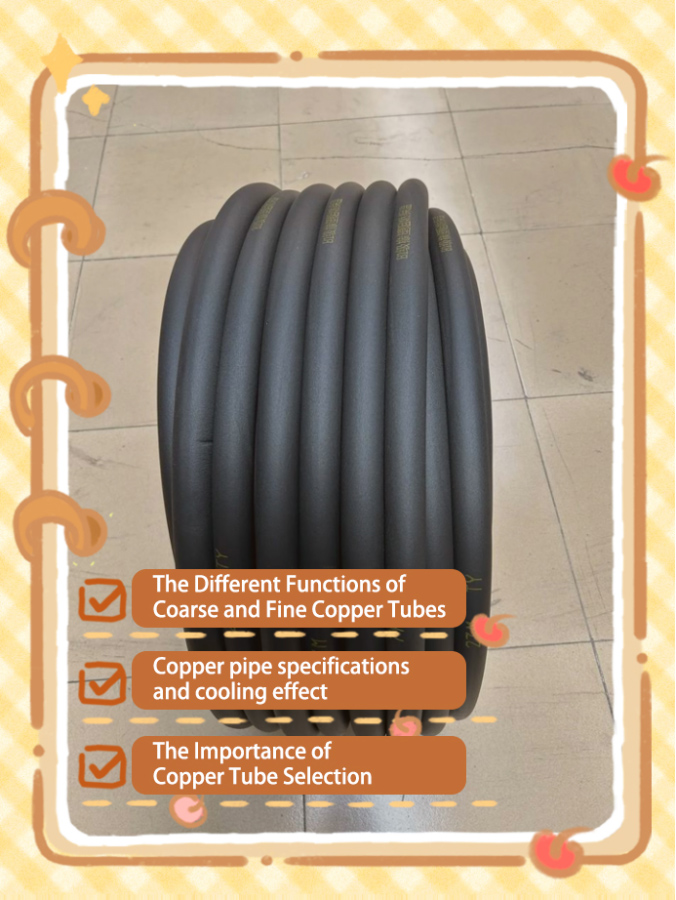
The function of the thick pipe: The thick pipe is usually a low-pressure pipe and is also called the return gas pipe. Its function is to ensure that the low-temperature and low-pressure gaseous refrigerant coming out of the evaporator can smoothly return to the compressor. In the refrigeration cycle, the refrigerant, after absorbing heat in the evaporator, turns into a low-temperature and low-pressure gaseous state and returns to the compressor through the thick pipe. The compressor then compresses it to become a high-temperature and high-pressure gaseous refrigerant, thus entering the next stage of the refrigeration cycle.
The function of the thin tube: The thin tube is generally a high-pressure tube and is also called a liquid tube. The high-temperature and high-pressure gaseous refrigerant discharged from the compressor is cooled by the condenser and then turns into medium-temperature and high-pressure liquid refrigerant, which flows through thin pipes to the expansion valve or throttling device. Then, after throttling and pressure reduction, the liquid refrigerant turns into a low-temperature and low-pressure liquid state and enters the evaporator to absorb heat and evaporate, achieving the refrigeration effect.
The wall thickness of copper tubes in air conditioners has a certain impact on the cooling capacity:
An increase in wall thickness is beneficial for the stability of cooling capacity: Appropriately increasing the wall thickness of copper tubes can reduce their deformation and vibration under high pressure, thereby enhancing the stability and reliability of the system. This helps maintain the normal operation of the refrigeration system and ensures a stable output of cooling capacity. Because if the copper tube undergoes significant deformation or vibration due to factors such as pressure during operation, it may affect the flow of the refrigerant, thereby causing fluctuations in the cooling capacity.
Excessive wall thickness will reduce the refrigeration efficiency; however, if the wall thickness of the copper tube is too thick, it will increase the thermal resistance of the copper tube. When the refrigerant flows in the copper tube, the resistance to heat transfer to the outside increases, which is not conducive to heat exchange between the refrigerant and the external environment. For instance, in the evaporator, the refrigerant needs to absorb heat from the room to evaporate and absorb heat. If the thermal resistance of the copper tubes is large and the heat transfer is not smooth, it will lead to insufficient heat absorption by the refrigerant, thereby reducing the cooling capacity. Meanwhile, excessive wall thickness will also increase costs and the weight of the system.
Excessive wall thickness may lead to a decrease in cooling capacity: If the wall thickness of copper tubes is too thin, they are prone to cracking and deformation under high pressure, causing refrigerant leakage and resulting in the refrigeration system being unable to operate normally, and the cooling capacity will naturally decline. Moreover, an overly thin wall thickness will also result in insufficient strength of the copper tubes, making it difficult for them to withstand the pressure during the operation of the refrigeration system, which will affect the stability and service life of the system.


